

close
Choose Your Site
Global
Social Media

Author: Site Editor Publish Time: 2026-10-21 Origin: Site
Ever struggled to secure a heavy hospital bed or an industrial access panel safely? Standard struts provide excellent lifting force, yet they fundamentally fail when you need to stop them mid-stroke. Mechanical latches often feel clunky and severely restrict your design options. In this post, we explore how specialized pneumatic components solve these exact engineering challenges. We will dive into selection criteria, structural variations, and essential safety protocols to help you specify the ideal motion control hardware for your next project.
Infinite Positioning: A specialized internal valve system allows users to stop and secure a load at any variable point along its entire stroke length.
Application-Specific Types: The choice between an elastic and a rigid locking mechanism depends entirely on whether the design requires shock absorption or absolute zero-movement stability under load.
Heavy-Duty Performance: Utilizing incompressible oil, specific struts provide immense holding force. This makes them indispensable for critical medical equipment and industrial machinery.
Precision Sizing: Proper specification requires calculating the exact force and stroke length, followed by integrating a compatible mechanical release system like a push-button or Bowden cable.
Safety First: Strict adherence to installation guidelines, such as proper rod-down orientation and avoiding side loads, prevents premature seal failure and ensures regulatory compliance.
To grasp the mechanics of advanced position control, it is essential to define what differentiates a standard strut from a locking variant. Standard gas struts are engineered to constantly exert an outward extension force. While they are highly effective for lifting and assisting heavy covers, they lack the ability to hold a load stationary at intermediate points without relying on external mechanical catches.
A locking gas spring elegantly solves this issue by integrating a built-in locking mechanism directly into the piston assembly. Specifically, this specialized internal architecture allows the operator to halt the stroke securely at any desired position. This completely eliminates the need for secondary locking hardware and streamlines the overall product design.
The core of this technology relies on a sophisticated internal valve system located within the piston rod itself.
Under normal resting conditions, the internal valve remains firmly closed. This isolates the nitrogen gas or oil inside the cylinder, preventing it from flowing between the two chambers separated by the piston. Because the medium cannot bypass the piston, the rod is locked solidly in place. Control is managed by a small release pin protruding from the threaded end of the piston rod. When an external mechanical force depresses this pin, the internal valve opens. This action creates a flow channel, allowing the internal fluid or gas to move freely across the piston.
While the pin remains depressed, the spring functions exactly like a standard strut, assisting the user in lifting or lowering the load. The moment the user releases the pin, the valve snaps shut instantly. Consequently, this traps the medium and locks the piston rod exactly where it stands, down to the millimeter.
The primary advantage of this mechanism is the concept of infinite positioning. Traditional mechanical locking arms rely on preset notches, drilled holes, or gear teeth. These physical constraints inherently restrict adjustments to specific, predefined increments. In contrast, a specialized locking strut allows for variable positioning anywhere along its travel path. This provides unparalleled ergonomic control, ensuring that movable components can be tailored perfectly to individual body types or shifting situational requirements.
Selecting the correct locking mechanism is a pivotal decision for engineers and procurement teams. The choice between an elastic and a rigid setup dictates exactly how the component will behave when subjected to external loads in its locked state.
In an elastic locking configuration, the internal valve locks the piston within a chamber filled predominantly with compressed nitrogen gas. Because gas is a naturally compressible medium, applying a heavy load to the piston rod while the valve is closed will cause the gas to compress slightly.
This physical compression creates a slight bounce or cushioning effect. While the locked position remains secure, it yields slightly under sudden weight or pressure. Therefore, this type is highly beneficial for applications where shock absorption actively enhances user comfort. Common use cases include reclining passenger seating in commercial buses, backrest adjustments on office chairs, and lightweight adjustable furniture where absolute rigidity is not a strict necessity.
When a design demands that a locked component remains completely stationary under heavy dynamic loads, a rigid locking gas spring is the mandatory choice. Instead of locking within a cushion of gas, the piston in a rigid strut locks within an oil-filled chamber.
Because hydraulic oil is physically incompressible, the piston simply cannot move once the valve closes. The resulting lock is completely solid, offering zero deflection. Engineers must further specify the direction of rigidity. Rigid in compression means the oil chamber is positioned so that pushing against the rod meets absolute resistance. This is vital for applications like hospital beds, where downward patient weight must never cause the backrest to sink. Conversely, rigid in tension resists pulling forces. This is utilized when a suspended load hangs from the spring, preventing any unwanted downward extension.
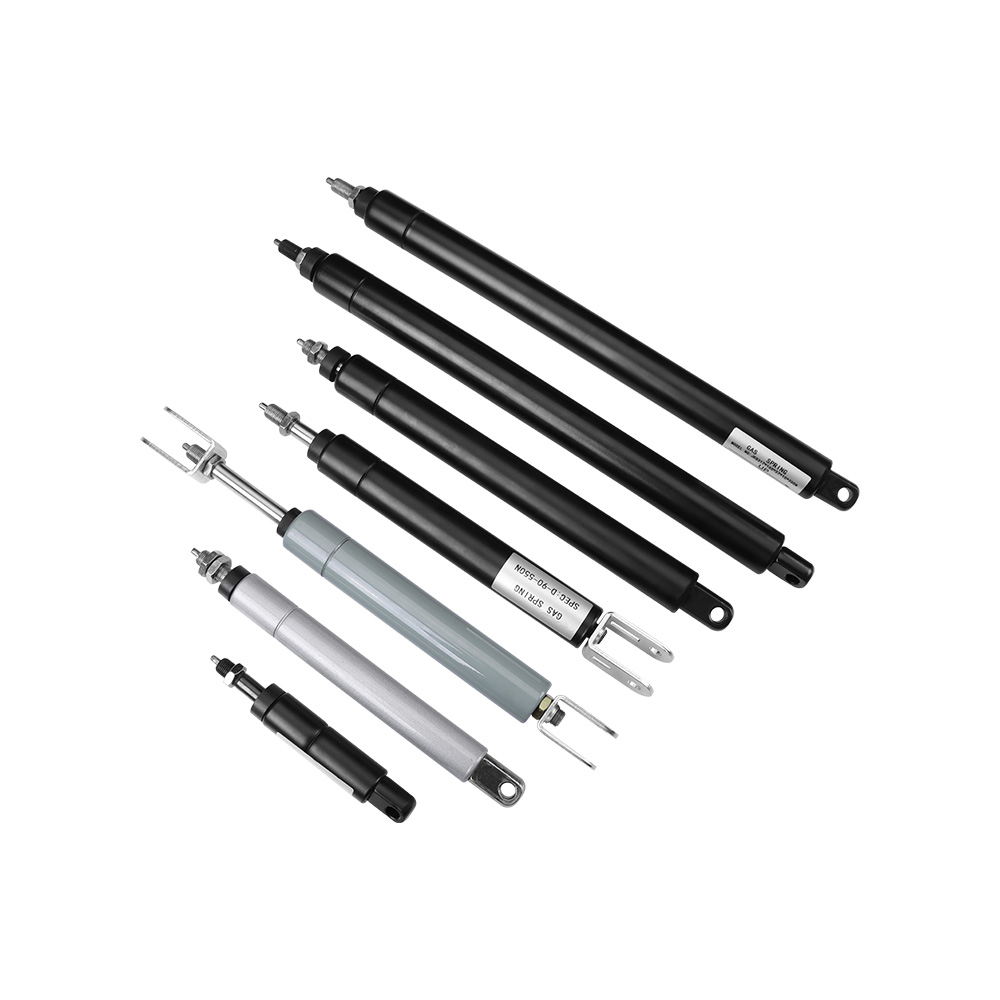
Determining whether a standard strut, a mechanical latch, or a specialized pneumatic lock is appropriate requires evaluating the specific physical demands of your design. If your application exhibits any of the following characteristics, integrating an adjustable locking support is likely the most effective engineering solution.
If the end-user needs to adjust an angle or height to their exact preference, preset mechanical holes are wholly insufficient. High-end ergonomic desks and drafting tables require infinite adjustment to accurately accommodate different working postures. A locking strut provides this seamless transition without forcing the user to wrestle with clunky pins or levers.
When an application requires a heavy access flap, protective cover, or seat to stay exactly where it is left without the user manually holding it in place, a locking spring becomes essential. This is particularly relevant in industrial environments. Operators often need both hands free to perform complex maintenance tasks safely, and a falling hatch could cause severe injury.
Many modern designs require lifting a heavy load while also locking it safely in a semi-open position. An armored vehicle hatch, for example, is too heavy to lift manually and far too dangerous to leave unsupported. A locking gas spring provides both the muscular lifting force and the critical safety lock in a single, streamlined component.
Recent market data highlights a massive shift toward ergonomic adaptability in both commercial and medical sectors. As occupational health and safety standards tighten globally, manufacturers are rapidly moving away from static equipment. Instead, there is a surging demand for motion control systems that allow infinite, user-defined positioning.
In the healthcare sector, the rapidly aging global population has accelerated the production of home-care beds, advanced mobility wheelchairs, and physical therapy stations. These devices require components that can bear sudden, heavy dynamic loads without the risk of collapsing, driving strict regulatory compliance. Furthermore, the modern workplace is heavily investing in sit-stand desks and adaptable seating. This trend pushes engineers to seek out reliable, non-electric positioning solutions that reduce maintenance costs, eliminate the need for complex wiring, and significantly enhance user comfort.
The versatility, durability, and precise control offered by these components make them critical across a wide range of demanding sectors. Below are the primary industries that rely heavily on this technology.
In the medical field, patient safety and equipment stability are paramount. A hydraulic locking strut is standard equipment in hospital beds, over-bed tables, tilt-in-space wheelchairs, and surgical tables. When a healthcare professional adjusts a patient's backrest, the mechanism must lift smoothly and lock rigidly in compression. This ensures the patient's shifting weight does not cause the bed to collapse or drop unexpectedly during critical care.
The modern workplace prioritizes user well-being. Premium ergonomic office chairs, massage tables, and industrial drafting stations utilize locking springs to allow users to transition between postures seamlessly. The infinite positioning capability ensures that the furniture adapts fluidly to the user, rather than forcing the user to adapt to rigid hardware.
Passenger comfort and space optimization drive interior design in the transportation sector. Reclining passenger seats in commercial buses, high-speed trains, and aircraft rely heavily on elastic locking springs. These components provide a comfortable, cushioned recline that actively absorbs the harsh vibrations of travel. In addition, specialized vehicle storage compartments use these struts for safe, controlled access during transit.
Objective evaluation of motion control components is crucial for B2B buyers and design engineers. While locking gas springs offer superior position control compared to many alternatives, they do possess specific limitations that must be factored into the initial design phase.
First and foremost, they offer millimeter-accurate adjustment without being restricted by the stepped increments of mechanical gears. Unlike electric linear actuators, these springs operate entirely on internal pneumatics and hydraulics. This makes them immune to power outages and ideal for mobile or off-grid applications. Furthermore, the units are permanently sealed and lubricated at the factory. They require no ongoing greasing or fluid top-offs, often lasting tens of thousands of cycles. Manufacturers can easily tailor the extension force, stroke length, and locking behavior to match exact project specifications.
Unlike a standard strut that moves simply by pushing or pulling the load, a locking spring requires a dedicated mechanical release system. Integrating cables, levers, or buttons adds a layer of design complexity to the overall product assembly. Additionally, the complex internal valving and precision sealing required for locking mechanisms make them more expensive upfront than standard non-locking gas struts. Finally, because they rely on internal gas pressure, extreme ambient temperature fluctuations can slightly alter the extension force, which remains a factor for outdoor applications.
Specifying the correct component is not a matter of guesswork. It requires precise mathematical calculation and a clear understanding of the application's physical dynamics. Follow these engineering guidelines to ensure optimal selection.
The extension force, measured in Newtons, is the most critical parameter. If the force is too low, the spring will fail to support the load. If it is too high, the user will struggle to compress the spring to adjust it. The calculation requires identifying the exact weight of the object, the distance from the hinge pivot point to the center of gravity, and the effective lever arm distance. In practical terms, engineers use CAD models to pinpoint these measurements and always factor in a safety margin to account for hinge friction and wear over time.
The physical dimensions of the strut dictate the mechanism's range of motion. You must calculate the geometric arc of your moving part to determine the required travel distance of the piston rod. Additionally, the compressed length must fit within your physical space constraints when the application is fully closed, preventing the strut from bottoming out and destroying the internal valve.
You must design a release interface tailored to the user. Direct push-buttons are ideal for close-quarters actuation, such as an armrest. Lever handles work best when the user's hand is near the mounting point. For remote actuation, Bowden cable systems are the industry standard, allowing the release button to be placed far away from the actual gas spring.
Mounting hardware dictates the structural longevity of the spring. While clevis forks provide a secure mechanical connection, ball and socket joints are highly recommended. Ball joints allow for slight multi-directional movement, which naturally absorbs minor frame misalignments and prevents detrimental side-loading on the piston rod.
Even the most precisely calculated gas spring will fail prematurely if installed incorrectly. Adhering to strict safety and installation guidelines protects the integrity of the internal seals and ensures compliance with industry regulations.
Unless specifically designed with an internal oil chamber for omni-directional use, gas springs should generally be installed with the piston rod pointing downward in their resting state. Gravity ensures that the internal lubricating oil constantly rests against the primary rod seal at the bottom of the cylinder. Keeping this seal wet prevents the rubber from drying out, cracking, and allowing the high-pressure nitrogen gas to escape.
Gas springs are engineered exclusively to handle axial loads, meaning forces applied straight along the length of the cylinder. They are not structural supports designed to handle lateral, side-to-side forces. Applying a side load forces the chrome-plated rod to scrape asymmetrically against the internal cylinder wall. Even a microscopic scratch on the rod will eventually shred the internal seal, leading to rapid pressure loss. Always ensure hinges are perfectly aligned and utilize flexible end fittings to mitigate stress.
A lockable gas spring represents the ultimate component for applications requiring both lifting assistance and secure, variable position control. By moving beyond the limitations of standard struts and clunky mechanical catches, designers can offer end-users infinite, smooth adjustability. Whether your project demands the shock-absorbing comfort of an elastic spring or the unyielding stability of a rigid hydraulic locking strut, careful calculation of force, stroke, and orientation is paramount. If you are ready to upgrade your product's ergonomics and safety, explore the high-performance options available at Mirui Gas Spring to find the exact specifications for your next build.
Generally, no. Gas springs are permanently sealed units manufactured under extreme pressure to ensure strict safety tolerances. The internal seals and micro-valves are not designed to be serviced or re-pressurized in the field. If a unit loses lifting force, fails to lock securely, or shows signs of hydraulic fluid leakage, it must be completely replaced to maintain operational safety.
A standard gas spring contains a simple piston with a small orifice that allows gas to pass through continuously. This means it constantly exerts an outward extension force and cannot be stopped mid-stroke without an external mechanical latch. In contrast, a locking gas spring incorporates a sophisticated internal valve system on the piston. When closed, this valve completely blocks the flow of gas or oil, stopping and securely holding the rod at any precise millimeter along its stroke.
The mechanism is released by depressing a small metal actuation pin located at the threaded end of the piston rod. Pushing this pin inward opens the internal valve. In practical product designs, this is usually achieved via an external accessory, such as a connected hand lever, a direct push-button, or a Bowden cable system that allows for remote actuation from a more convenient location on the equipment.
Yes, rigid locking gas springs are specifically engineered for heavy-duty load bearing. Because they utilize an internal chamber filled with hydraulic oil, and because oil is a non-compressible fluid, the locking mechanism is completely solid. Depending on the specific cylinder diameter and internal design, these struts can safely hold thousands of Newtons of force without giving way or bouncing, making them the standard choice for heavy medical tables and industrial machinery.


