

close
Choose Your Site
Global
Social Media

Author: Site Editor Publish Time: 2026-07-04 Origin: Site
Standard gas springs provide a fixed force output. They solve basic lifting needs effectively on simple enclosures. But complex engineering and ergonomic applications require dynamic load management. Passive motion control often fails when operators need precision holding or sequencing.
We introduce the Controllable Gas Spring as the definitive solution. These devices excel in scenarios demanding precision stopping, variable resistance, or delayed return capabilities. An adjustable gas spring empowers designers to tune output forces directly in the field. These specialized components easily overcome the rigid limitations inherent in standard gas struts.
Read on to discover how engineering teams evaluate these advanced components. Upgrading helps you reduce tooling wear and improve overall ergonomics. You will learn to navigate key dimensions like locking mechanisms, seal integrity, and safety compliance. We also share practical implementation realities to guarantee success in your next product rollout.
Precision Control: Controllable gas springs allow engineers to lock strokes at variable positions or delay return phases, solving issues fixed-force springs cannot.
Primary Applications: Extensively utilized in tool and die operations (delayed return), medical beds, heavy-duty ergonomic seating, and aerospace enclosures.
Evaluation Criteria: Selection hinges on locking type (rigid vs. elastic), stroke length, environmental durability, and exact load-bearing requirements.
Risk Management: Proper implementation requires assessing seal degradation, temperature limits, and compliance with strict safety standards.
Engineering teams frequently encounter a major friction point during mechanical design. Standard springs cannot adapt to changing weight loads. If you add an accessory to a hatch, the original spring suddenly fails to hold the door open. Engineers also struggle when mechanisms require mid-stroke stopping capabilities. Standard struts simply push open or compress fully. They offer zero middle ground. Complex sequencing requires precise holding forces at very specific stroke intervals. Fixed-force units lack the internal valving necessary for this nuanced control. The resulting limitation forces designers to compromise on product functionality.
This lack of control creates severe downstream consequences. High-speed manufacturing environments expose these weaknesses daily. Standard units return to their extended positions immediately upon load release. This rapid bounce-back increases wear on delicate tool-and-die setups. Sudden impacts degrade metal stamping dies over time. Furthermore, poor ergonomics plague manual handling operations. Operators must constantly fight against the full extension force of standard struts. This daily strain reduces worker efficiency and increases injury risks. The combination of tool wear and operator fatigue translates directly into higher long-term replacement costs.
Transitioning to controllable units represents a strategic upfront investment. Smart engineering teams view this upgrade as a core reliability measure. Controllable units prevent catastrophic linkage failures by eliminating sudden, uncontrolled movements. They protect surrounding hinges, brackets, and structural frames from kinetic shock. A properly specified system reduces maintenance downtime significantly. You replace components less often because the controlled motion preserves the entire mechanical assembly. This proactive approach to design ensures continuous operation and protects your initial engineering investments.
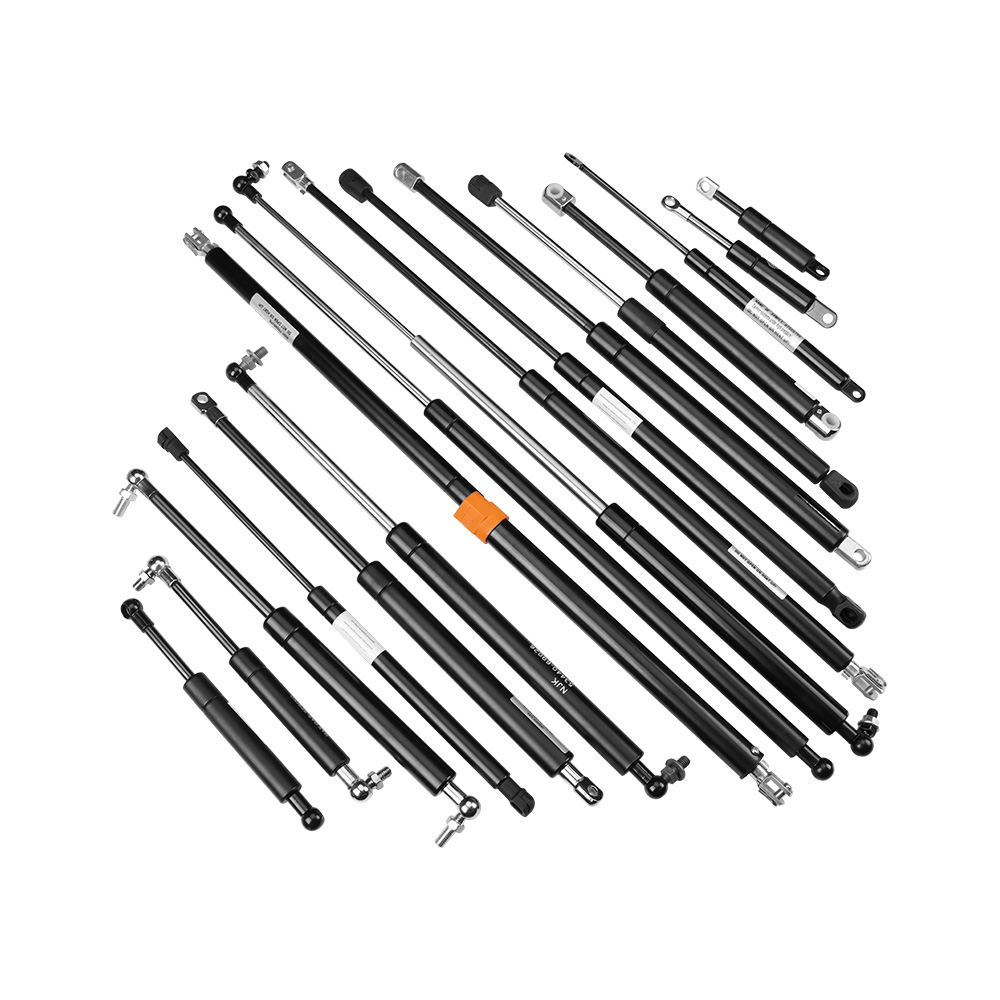
Metal stamping requires flawless timing. Controllable units utilizing delayed return mechanisms dominate this sector. They hold a pad or stripper plate down securely while the press completes its downward cycle. This holding action proves critical for material stability.
Force Application: The press compresses the spring, storing energy.
Dwell Time: Internal valving delays the return stroke.
Controlled Release: The spring extends only after the forming tool retracts fully.
This precise sequencing prevents part distortion. It allows manufacturers to integrate these components seamlessly into high-speed stamping operations. You achieve higher quality yields because the material cannot shift during the critical forming phase.
Human-centric designs demand absolute stability. We see these units applied extensively in medical beds, industrial seating, and drafting tables. A patient bed must remain completely immobile once adjusted. Standard springs exhibit an unacceptable spongy feeling under varying loads.
Absolute Stability: Internal oil chambers create a zero-give locking mechanism.
Tension and Compression: The lock holds firm against pulling and pushing forces alike.
Variable Positioning: Users can stop the movement exactly where they need it.
This rigid locking ensures the application remains stable under heavy human or mechanical weight. Operators gain confidence knowing the equipment will not collapse or drift out of position.
Space and weight dictate design parameters in transportation. Access panels and cargo doors frequently require variable opening angles based on tight spatial constraints. A single door design might face different payload weights depending on the specific vehicle model. Incorporating an adjustable gas spring mechanism solves this discrepancy perfectly. Manufacturers account for varying payload weights without requiring expensive part redesigns. Mechanics simply bleed off excess pressure to match the exact lifting requirement. This adaptability streamlines manufacturing and simplifies spare parts inventory across multiple vehicle platforms.
Defining the desired outcome dictates your locking mechanism choice. You must understand the internal fluid dynamics to make the correct selection. We summarize the fundamental differences in the chart below.
| Feature | Elastic Locking | Rigid Locking |
|---|---|---|
| Internal Medium | Nitrogen Gas | Oil / Hydraulic Fluid |
| Performance Characteristic | Slight bounce or give when locked | Absolute zero-give stability |
| Primary Benefit | Excellent shock absorption | Maximum load-bearing safety |
| Ideal Application | Passenger seating, lightweight panels | Medical beds, heavy-duty machinery |
Elastic locking utilizes compressible nitrogen gas within the locking chamber. This creates a cushioning effect upon impact. Rigid locking relies on incompressible oil. When the valve closes, the oil forms an unyielding barrier. This provides zero-give stability under extremely heavy loads.
Matching component capabilities to your project lifecycle requires precision. An adjustable unit features a specialized release valve. This valve lets you dial in the exact force needed for your specific stroke length. If the initial force pushes a hatch open too aggressively, you simply release small bursts of nitrogen. This tuning process aligns the upward force precisely against the gravitational pull of the door. Properly balancing these forces extends the lifecycle of hinges and mounting brackets. You avoid over-stressing the mechanical linkages during daily operation.
Evaluating internal components separates reliable products from early failures. Nitrogen gas retention rates depend entirely on seal quality. Manufacturers typically utilize Nitrile Butadiene Rubber (NBR) for standard environments. However, high-heat applications demand Fluoropolymer elastomers like Viton. These premium seals resist degradation under extreme thermal stress.
Piston rod treatments also play a massive role in lifespan. Surfaces treated with QPQ (Quench Polish Quench) or hard chrome plating reduce internal friction significantly. A smoother rod prevents microscopic tears in the sealing lip. We recommend verifying these material specifications based on your anticipated operating cycles. A unit rated for 100,000 cycles requires superior surface finishes to maintain consistent pressure over time.
Pressurized cylinders carry inherent risks. You must verify manufacturer compliance with strict directive safety requirements. European markets require adherence to Pressure Equipment Directives (PED). Global supply chains also demand RoHS and REACH compliance to eliminate hazardous substances. Reputable manufacturers perform destructive testing to establish burst pressure limits. They document these limits transparently. Incorporating compliant components protects end-users from sudden explosive decompression. It also shields your engineering firm from severe liability issues.
Physical reality often complicates theoretical designs. Controllable springs demand specific mounting orientations to function correctly. You must typically mount these units rod down. This orientation keeps the internal oil resting against the main seal. The oil provides constant lubrication to the rubber components. If you mount the cylinder rod up, the oil pools at the wrong end. The seals dry out quickly. Dry seals crack, allowing pressurized nitrogen to escape. You must account for these spatial constraints early in the CAD modeling phase to ensure proper mounting angles.
Environmental conditions alter performance drastically. Charles's Law dictates how extreme temperatures alter internal gas pressure. Heat causes the nitrogen molecules to expand rapidly. This expansion shifts the force profile upward, making doors harder to close. Conversely, freezing temperatures cause the gas to contract. A hatch that opens smoothly in a warm factory might fall shut in a sub-zero environment. You must analyze these temperature extremes during the specification phase. Failing to account for thermal expansion causes system failure if not correctly specified.
Lockable units require external triggers to release their internal valves. You must assess the complexity of routing release cables or hydraulic actuation levers early on. Tight product assemblies often force engineers into sharp cable bends. A Bowden cable bent past its minimum radius will bind. This binding prevents the internal pin from returning to its locked position. The spring then behaves like a standard free-moving strut. We recommend planning clear, sweeping pathways for all actuation cables. You might also consider rigid mechanical levers if space permits, as they eliminate cable-binding risks entirely.
Establishing strict baseline metrics guarantees better procurement outcomes. You cannot source components based on vague requirements. Engineering teams must define the exact force required in Newtons. You also need a firm requirement for lock strength. How much external force will the locked unit withstand before the internal valve yields? Finally, establish a mandatory cycle life. Specify whether the application requires 50,000 actuations or 250,000 actuations. These hard metrics quickly filter out inadequate suppliers.
The prototyping phase demands flexibility. Ordering a fully adjustable unit for early testing represents a critical best practice. Engineering models rarely predict physical friction perfectly. You use the adjustable unit to dial in the exact force manually on the physical prototype. Once you discover the perfect operational pressure, you record that data. You then use this real-world data to order fixed-force or custom-valved production runs. This two-step process eliminates guesswork and prevents massive manufacturing errors.
We rely on objective data to select manufacturing partners. You should look for suppliers offering transparent load-testing data. They must provide detailed 3D CAD models to streamline your design integration. Verifiable field-failure rates separate elite manufacturers from average ones. We summarize the vendor evaluation logic below.
| Evaluation Metric | Red Flag (Avoid) | Green Flag (Select) |
|---|---|---|
| Testing Transparency | Refuses to share raw cycle-test data | Provides independent lab testing reports |
| Engineering Support | Only provides 2D PDF drawings | Supplies native 3D STEP files |
| Material Traceability | Vague references to "rubber seals" | Specifies NBR or Viton compounds |
| Quality Control | No batch tracking available | Laser-etched serial numbers on every unit |
A controllable unit bridges the gap between passive motion control and active mechanical reliability. Standard fixed-force components simply cannot handle complex ergonomic demands or high-speed tooling delays. Upgrading to a specialized locking or adjustable system protects your structural linkages from kinetic shock. It also ensures user safety across varying weight loads.
We emphasize objective testing and rigorous environment matching over price-driven purchasing. You must account for mounting orientations, temperature extremes, and exact locking forces during the design phase. Take action today by defining your cycle-life requirements clearly. Consult an engineering specialist, download a sizing calculator, or request a technical datasheet for your specific application.
A: A standard unit contains a permanently sealed volume of pressurized nitrogen, providing one fixed force. An adjustable unit features a specialized bleed valve. This valve allows engineers to manually release small amounts of gas. You use this mechanism to tune the upward force precisely to match your specific application weight.
A: Yes. Most lockable units offer infinite positioning across the entire stroke length. When the operator releases the actuation lever, the internal valve closes immediately. The piston rod stops exactly at that point. Some specialized variants do offer predetermined stroke locks, but infinite positioning remains the industry standard.
A: You release the lock by depressing a small mechanical pin located on the piston rod. Pushing this pin opens the internal valve, allowing fluid or gas to flow through the piston. Designers typically actuate this pin using connected Bowden cables, hydraulic push buttons, or direct mechanical levers.
A: If pressure drops due to seal wear, the unit loses its lifting capability. The attached door or hatch will become heavy and may fail to stay open. However, rigid locking models often maintain their holding position even if gas pressure drops, preventing sudden collapses and providing built-in safety redundancy.


