

close
Choose Your Site
Global
Social Media

Author: Site Editor Publish Time: 2026-08-31 Origin: Site
A mechanical failure in a pneumatic desk usually presents in one of two frustrating ways. It either requires excessive physical exertion to push down, or it completely lacks the upward force necessary to lift heavy workstation equipment. When you have to lean your entire body weight onto a desk surface just to lower it, or physically haul the top upward to transition to a standing position, the pneumatic system has failed. These failures stem directly from improper force calculation during the design or replacement phase.
The physics of pneumatic height-adjustable tables require precision. The upward force of the strut must perfectly counterbalance the combined static weight of the desk surface and the dynamic load of monitors, mounts, and peripherals. Achieving smooth, safe, and reliable ergonomic adjustments demands precise force calculation measured in Newtons, proper component selection, and a thorough understanding of mounting geometry to ensure the workstation operates flawlessly at any height.
Force is dictated by total load and mounting geometry: Calculating the correct Newton (N) rating requires factoring in the desk's maximum loaded weight, stroke length, and the specific pivot or mounting angles.
Locking mechanisms are non-negotiable for desks: Unlike standard compression struts, a controllable gas spring is required to hold a desk firmly at variable heights without drifting.
Safety margins prevent failure: A standard 10% to 15% force buffer is necessary to account for internal friction, gas permeation over time, and unexpected minor weight additions.
Chair cylinders do not translate to desks: An office chair gas lift operates on entirely different stroke lengths, load distributions, and actuation mechanisms than a desk riser.
Architecture dictates leverage: The structural design of the desk (e.g., X-lift risers, Z-lift frames, or hinged drafting tables) fundamentally alters the required force output.
The baseline physics of a Desk Gas Spring rely on pressurized nitrogen gas contained within a sealed steel cylinder. This internal pressure pushes against the piston rod, generating a fixed upward force that acts as a counterweight against gravity. When you actuate the release valve, this stored energy handles the heavy lifting, raising the desk surface and its accumulated equipment load with minimal physical effort.
Lowering the desk requires downward resistance. You must apply manual downward pressure which, when combined with the total weight of the desk and equipment, overcomes the internal gas pressure. If the cylinder's Newton rating perfectly matches the load, this downward adjustment feels smooth and controlled. A mismatch here results in a desk that either crashes downward uncontrollably or refuses to lower without significant physical strain on your shoulders and back.
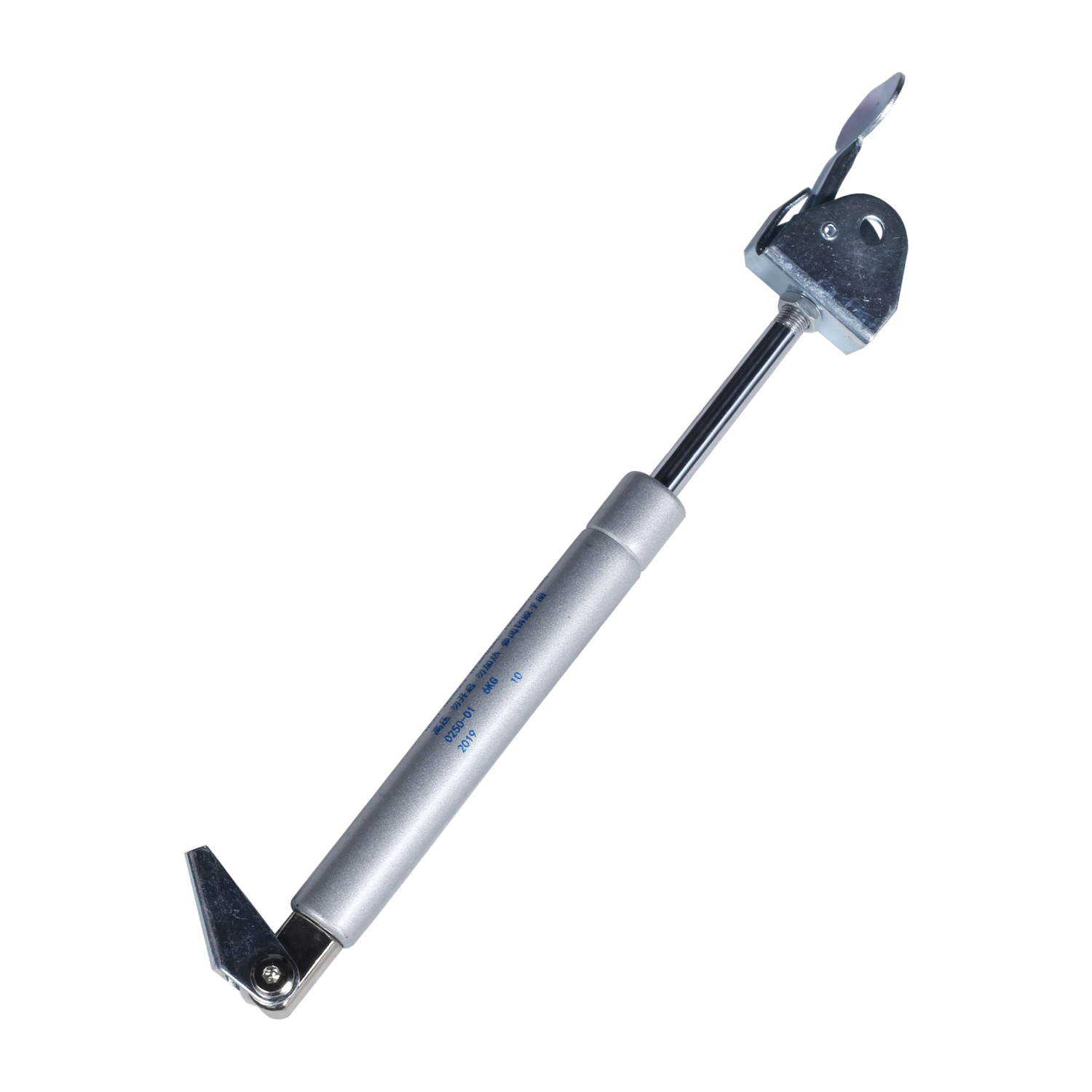
Standard compression struts, like those found on car hatchbacks, push open and stay open at full extension. They lack the internal valving to stop mid-stroke. Desk applications require a highly specialized internal mechanism found in a controllable gas spring. This unit features a release pin at the end of the piston rod. Pressing this pin opens a valve, allowing nitrogen to bypass the piston. Releasing the pin snaps the valve shut, locking the rod instantly in its current position.
For standing desks, rigid locking is mandatory. Locking mechanisms come in elastic and rigid variations. Elastic locking leaves a small pocket of uncompressed gas, allowing a slight bounce. This is unacceptable for a work surface. Rigid locking uses an oil barrier to completely isolate the piston, ensuring zero compression or deflection once the valve is closed. Without a rigid lock, the work surface bounces under the repetitive pressure of typing, destroying the stability of the workstation.
Accurate force calculation begins with a strict audit of the desk's total load. You cannot guess these numbers; you must weigh the components. Static weight refers to the permanent physical structure of the desk top itself. Material choice heavily influences this baseline number.
Common Desk Surface Weights (Static Load)
| Material Type | Thickness | Estimated Weight per Sq. Ft. | Total Weight (Standard 60"x30" Desk) |
|---|---|---|---|
| Medium-Density Fiberboard (MDF) | 1 inch | 4.0 lbs | 50 lbs |
| Plywood (Birch/Oak veneer) | 1 inch | 3.0 lbs | 37.5 lbs |
| Solid Hardwood (Walnut/Oak) | 1.5 inches | 5.5 lbs | 68.75 lbs |
| Epoxy Resin River Table | 1.5 inches | 7.0 lbs | 87.5 lbs |
Dynamic load encompasses everything placed on top of the desk. Workstations rarely remain static in their equipment loadouts. You must account for multiple heavy components to find the maximum potential load.
Average Dynamic Load Weights
| Equipment Type | Average Weight Range |
|---|---|
| 27-inch Monitor (without stand) | 10 - 15 lbs |
| Dual Articulating Monitor Arm | 12 - 18 lbs |
| 15-inch Laptop | 4 - 6 lbs |
| Mechanical Keyboard & Mouse | 3 - 5 lbs |
| Desktop Speakers (Pair) | 8 - 12 lbs |
Failing to account for the maximum potential dynamic load guarantees the desk will sag over time. Always calculate your required force based on the heaviest anticipated equipment configuration.
Stroke length defines the total vertical travel distance of the desk. A standard sit-to-stand desk requires between 14 to 20 inches of vertical travel to accommodate a wide range of human heights. The stroke length directly dictates the internal volume of the cylinder and the pressure dynamics required to maintain consistent force.
To measure a desk for a replacement cylinder, follow these exact steps:
Fully extend the desk to its absolute highest position and lock it in place.
Measure the exposed chrome piston rod from the cylinder body to the end mount. This measurement is your stroke length.
Measure from the center of the top mounting hole to the center of the bottom mounting hole. This is your extended length.
Subtract the stroke length from the extended length to determine the compressed length.
If you install a cylinder with a compressed length that is too long, the desk will bottom out early and fail to reach a proper seated ergonomic height.
The structural design of the desk frame fundamentally alters how force is applied. Direct vertical lifts operate on a straightforward 1:1 force ratio. If the total load is 100 pounds, the upward force required is 100 pounds, distributed evenly across the lifting columns.
X-lift and Z-lift desk risers introduce complex mechanical disadvantages. These scissor-like structures rely on pivot points and leverage. A strut pushing horizontally against an X-lift frame must exert significantly more force to lift a vertical load. The required Newton rating increases dramatically due to the loss of leverage at the lowest positions.
Mechanical Advantage Loss in X-Lift Frames
| Desk Position | Strut Mounting Angle | Force Multiplier Required |
|---|---|---|
| Fully Raised | 45 Degrees | 1.4x Total Load |
| Mid-Height | 30 Degrees | 2.0x Total Load |
| Fully Lowered | 15 Degrees | 3.8x Total Load |
Hinged drafting tables present a different geometry entirely. Force is calculated based on holding a flat lid open at a specific angle. The distance from the hinge pivot to the strut mounting point, and the distance to the lid's center of gravity, dictate the required force.
To determine the exact force required for angled or hinged applications, engineers rely on a standard formula framework:
Force (F) = (Weight (W) x Distance to Center of Gravity (D1)) / (Number of Springs (n) x Distance to Pivot/Mount (D2)).
In this equation, the distance to the center of gravity and the distance to the mounting point are critical variables. Moving the mounting point just one inch closer to the hinge drastically increases the required force output from the cylinder.
For direct vertical lift desk risers, the formula simplifies significantly. Because there are no pivot angles reducing leverage, the equation adapts to:
Force (F) = Total Weight (W) / Number of Springs (n).
This simplified vertical lift calculation assumes a 1:1 transfer of force, making it much easier to specify struts for standard dual-column standing desks.
Gas springs are globally rated in Newtons (N). Therefore, imperial or metric weight measurements must be converted before specifying a part. The baseline conversion metrics are straightforward: 1 kilogram equals approximately 9.81 Newtons, and 1 pound equals approximately 4.45 Newtons.
Consider a practical example of a standard workstation setup. A solid wood desk top weighs 60 lbs, and the dynamic load of dual monitors, arms, and a laptop totals 40 lbs. The combined total weight is 100 lbs.
Convert pounds to kilograms: 100 lbs / 2.204 = 45.35 kg.
Convert kilograms to Newtons: 45.35 kg x 9.81 = 445 Newtons.
If this desk utilizes two vertical lifting columns, divide the total force by two. Each strut must support roughly 222.5 Newtons as a baseline.
Calculations on paper represent a perfect mechanical environment. In reality, internal seal friction within the cylinder causes a slight loss of force. The tight rubber tolerances required to keep pressurized nitrogen from escaping inherently create drag against the piston rod during actuation.
To counteract friction and natural wear, you must add a 15% safety margin to the final Newton calculation. Over a multi-year lifespan, even the highest quality seals allow trace amounts of gas permeation, resulting in a slow loss of pressure. Adding a 15% buffer prevents the desk from sagging prematurely as the strut ages.
Force Conversion Matrix (lbs to Newtons with 15% Buffer)
| Total Load (lbs) | Total Load (kg) | Baseline Force (Newtons) | Recommended Rating w/ 15% Buffer |
|---|---|---|---|
| 50 lbs | 22.6 kg | 222 N | 255 N |
| 75 lbs | 34.0 kg | 333 N | 383 N |
| 100 lbs | 45.3 kg | 445 N | 511 N |
| 125 lbs | 56.7 kg | 556 N | 639 N |
| 150 lbs | 68.0 kg | 667 N | 767 N |
A common mistake in DIY desk builds is attempting to repurpose seating pneumatics for lifting tables. An office chair gas lift is engineered for a completely different set of mechanical realities. Chair lifts handle high-impact, centralized vertical loads—specifically, the sudden drop of human body weight. They feature very short stroke lengths, typically ranging from 4 to 6 inches, which is entirely insufficient for a sit-to-stand desk requiring up to 20 inches of travel.
Furthermore, the actuation mechanisms are incompatible. Chair cylinders rely on a simple top-button release pressed by a lever integrated into the seat mechanism. Desk risers require complex, cable-actuated side-lever releases that trigger the valve pin remotely from the edge of the desk. Attempting to adapt a top-button release for a wide desk surface results in clumsy, unreliable actuation.
The internal valving of seating pneumatics prioritizes human comfort over rigid stability. A chair adjustment gas spring utilizes elastic locking. When the valve is closed, a small amount of gas remains compressible between the piston and the oil barrier, creating a shock-absorbing cushion. This elasticity prevents spinal compression when a user sits down heavily.
If you apply elastic locking to a desk, the work surface bounces every time you lean on it or type aggressively. Desks demand rigid locking struts where the oil chamber completely isolates the piston, ensuring zero compression or deflection once the valve is closed. The structural requirements for a stable typing surface mandate rigid locking, rendering chair springs useless for table applications.
Specifying a strut with a Newton rating significantly higher than the actual load creates a dangerous user experience. When a desk is over-pressurized, the upward force vastly exceeds the downward weight of the equipment. Upon triggering the release lever, the desk shoots upward violently. This catapult effect damages expensive monitors, snaps cables, and can strike the user in the jaw or chest.
Lowering an over-pressurized desk is equally problematic. You must drape your entire upper body over the desk, using your full body weight to overcome the excessive upward force. This defeats the purpose of an ergonomic workstation and quickly leads to back strain and user fatigue.
Under-pressurization is a quieter, but equally frustrating failure mode. When the Newton rating falls short of the dynamic load, the desk loses its ability to maintain height. You raise the desk to a standing position, lock it, and begin working. Slowly, under the weight of dual monitors and heavy typing hands, the desk begins to sink.
This desk sag renders the standing feature useless. Users often attempt to fix this by removing equipment, which compromises their workflow. Under-pressurization usually occurs when builders fail to account for the weight of heavy monitor arms or neglect to add the 15% safety buffer during the calculation phase.
Building a custom convertible standing desk introduces complex geometry challenges. Finding the correct length, weight capacity, and installation angles for gas struts in non-standard geometries requires extensive prototyping. Builders must account for the thickness of custom wood tops and the specific pivot points of their chosen hinges or scissor lifts.
When dealing with uncommon installations, prototyping with adjustable mounting brackets is mandatory. Adjustable brackets feature multiple mounting holes spaced half an inch apart, allowing you to move the leverage point forward or backward. This fine-tunes the mechanical advantage, allowing you to perfectly balance the strut's force against the desk's weight without having to buy multiple different cylinders.
Commercial desk risers eventually require maintenance. Replacing a failed gas spring is a straightforward process if you follow strict safety protocols.
Remove all monitors, laptops, and equipment from the desk to eliminate the dynamic load.
Raise the desk frame to its fully extended position and lock it.
Secure the lifting columns using heavy-duty C-clamps or wooden blocks to prevent the heavy frame from collapsing during disassembly.
Disconnect the release cable from the valve head on the cylinder.
Unbolt the top and bottom mounting clevises and remove the dead cylinder.
Locate the printed Newton (N) rating on the old cylinder housing. It is usually stamped on the thickest part of the black tube, formatted as a number followed by an "N" (e.g., 400N). Match this rating exactly on the replacement part.
High-quality pneumatic components undergo rigorous cycle testing. A standard commercial desk strut survives 50,000 to 100,000 actuations before seal degradation impacts performance. This translates to roughly 5 to 10 years of daily use. However, lifespan is heavily influenced by environmental factors and maintenance.
Extreme temperature fluctuations affect the internal gas pressure, causing the desk to feel slightly stiffer in winter and softer in summer. Maintenance is minimal but critical. Keep the exposed chrome piston rod entirely free of dust, pet hair, and adhesive residue. If debris drags past the main seal during compression, it scores the rubber, leading to rapid gas permeation and premature failure. Wipe the rod with a dry microfiber cloth once a month.
When sourcing components, you face a choice between off-the-shelf sizing and custom force calibration. Pre-charged standard struts are readily available, cost-effective, and ship quickly. However, they are only available in fixed Newton increments (e.g., 200N, 250N, 300N). If your calculation demands exactly 275N, an off-the-shelf option forces you to compromise on either side of optimal performance.
Custom-calibrated struts are essential for bespoke desk builds and high-end commercial furniture manufacturing. Suppliers charge the cylinder to the exact Newton specification required by the frame's geometry. This guarantees flawless actuation and eliminates the catapult or sag effects associated with mismatched off-the-shelf parts.
The reliability of a pneumatic cylinder depends entirely on the manufacturer's quality control standards. When evaluating suppliers, prioritize those operating under ISO 9001 manufacturing standards. This ensures consistent machining tolerances for the internal valves and seals.
For office furniture applications, BIFMA (Business and Institutional Furniture Manufacturers Association) compliance is a strong indicator of durability. BIFMA testing subjects the desk and its pneumatic components to extreme weight and cycle testing to ensure commercial-grade longevity. Verify that the cylinder housing has undergone rigorous salt-spray testing to guarantee resistance against corrosion and rust over the product's lifespan.
To move forward with a repair or custom build, follow these actionable steps:
Weigh your desk top and all dynamic equipment using a digital scale to establish a precise total load baseline.
Measure the extended length and stroke length of your current setup to ensure the replacement cylinder fits the physical frame limits.
Calculate the required force in Newtons and add a 15% safety buffer to counteract internal seal friction.
Specify a rigidly controllable gas spring with a cable-actuated release valve to prevent surface bounce during typing.
A: Measure the required stroke length and the fully extended length of your desk frame. Weigh the desk top and all equipment. Convert this total weight to Newtons and factor in the desk's lifting mechanism to determine the necessary force rating.
A: Generally, no. Most standard gas springs are sealed units charged to a specific pressure at the factory. Some specialized adjustable struts feature a release valve to let gas out, reducing force, but you cannot add pressure back in once released.
A: Your desk likely uses an elastic locking gas spring, which leaves a cushion of compressible gas in the chamber to absorb shock. Desks require rigid locking gas springs, which use an oil barrier to completely lock the piston in place, preventing any bounce.
A: A high-quality commercial desk strut is typically rated for 50,000 to 100,000 actuations. Depending on daily usage, this translates to roughly 5 to 10 years of reliable service before internal seal wear causes noticeable pressure loss.
A: Installing a strut upside down prevents the internal oil from lubricating the main seal. This causes the seal to dry out, crack, and leak nitrogen gas rapidly. Always install the strut with the thicker cylinder tube pointing upward and the thinner rod pointing downward.
A: Yes. A drafting table requires a controllable locking gas spring to hold the work surface steady at various specific angles. A standard compression strut pushes the table to its maximum open position and refuses to hold a mid-range angle under the pressure of drawing.


