

close
Choose Your Site
Global
Social Media

Author: Site Editor Publish Time: 2026-04-01 Origin: Site
A Hydraulic Gas Spring works by combining compressed gas with hydraulic oil damping to create controlled lifting, lowering, locking, or positioning force. In simple terms, a Hydraulic Gas Spring stores energy in compressed nitrogen, then releases that energy through a piston-and-cylinder system while hydraulic resistance slows the motion for better stability. That is why a Hydraulic Gas Spring is widely used where users need both force and control rather than a fast, bouncing spring action. In modern applications, a Hydraulic Gas Spring is common in industrial machinery, automotive components, adjustable furniture, cabinets, learning tables, gaming equipment, and heavy-duty access panels. The main benefit of a Hydraulic Gas Spring is that it does not just push or lift; it manages movement in a smooth, safe, and predictable way. Product information provided for MIRUI’s range also shows this positioning clearly, with models focused on adjustable lockable lifting, cabinet support, machine lift assistance, and controlled damper-supported motion.
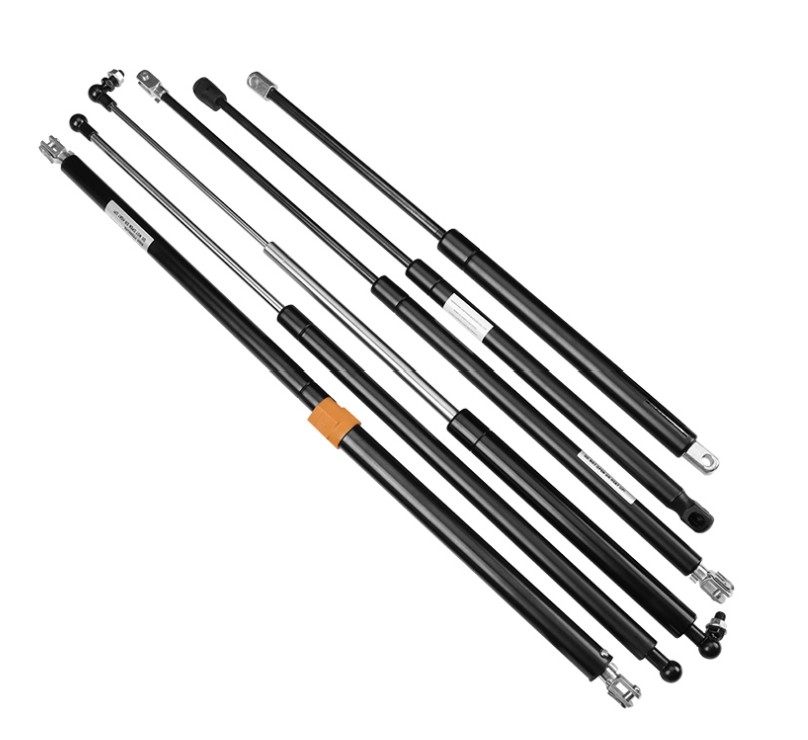
A Hydraulic Gas Spring is a motion-control component that contains pressurized gas, usually nitrogen, inside a sealed cylinder. When the rod moves in or out, the internal gas pressure generates force. What makes a Hydraulic Gas Spring different from a standard gas spring is the added hydraulic function. The hydraulic oil inside the unit controls speed, absorbs shock, and improves stability. As a result, a Hydraulic Gas Spring is especially useful in equipment that must avoid sudden drops, hard impacts, or uncontrolled rebound. In practice, this means a Hydraulic Gas Spring is ideal for lifting heavy lids, positioning machine covers, supporting adjustable desks, and assisting ergonomic furniture or equipment where precise movement matters.
The operating principle of a Hydraulic Gas Spring can be broken into a few stages:
Gas compression creates force
Inside the cylinder, nitrogen gas is compressed. This stored energy is what gives a Hydraulic Gas Spring its extension force.
The piston rod moves through oil and gas chambers
When an external load pushes the rod inward, the internal gas is compressed further. When the load is released, the gas expands and drives the rod outward. In a Hydraulic Gas Spring, this movement is moderated by hydraulic fluid.
Hydraulic damping controls speed
The oil flows through internal valves or restricted passages. This slows extension or compression, so the Hydraulic Gas Spring moves smoothly rather than snapping open.
Force remains more consistent across the stroke
A Hydraulic Gas Spring can deliver relatively stable force across a working range, which is important for predictable performance in lifting or supporting tasks.
Optional locking adds position control
Some designs include a locking mechanism, allowing the Hydraulic Gas Spring to hold a table, panel, or platform at a selected position.
This is why a Hydraulic Gas Spring is often preferred over a basic mechanical spring in applications that require both assistance and motion management. MIRUI’s uploaded product information specifically highlights smooth adjustment, secure locking, durability, and stability in applications such as learning tables, cabinets, industrial machines, and gaming equipment.
A typical Hydraulic Gas Spring includes the following parts:
Component | Function in a Hydraulic Gas Spring | Why it matters |
|---|---|---|
Cylinder | Sealed housing for gas and oil | Maintains internal pressure |
Piston rod | Transfers movement in and out | Converts internal force into motion |
Nitrogen gas | Main energy source | Provides extension force |
Hydraulic oil | Damps and controls movement | Prevents sudden motion |
Piston and valve system | Regulates internal flow | Improves precision and safety |
End fittings | Connects the spring to equipment | Supports flexible installation |
Seal package | Prevents leakage | Extends service life |
In many industrial designs, a Hydraulic Gas Spring may also include special connectors such as ball ends, double ears, or plated fittings for different load paths and mounting requirements. MIRUI’s product range references metal ball ending, double ears, zinc plating, and lockable designs, which indicates that its Hydraulic Gas Spring solutions are meant for varied mechanical layouts and operating environments.
The reason buyers search for a Hydraulic Gas Spring rather than a standard spring is usually motion quality. A standard spring only stores and releases energy. A Hydraulic Gas Spring adds damping, which changes the user experience and the engineering performance.
The advantages include:
Smoother opening and closing
Reduced impact at end of stroke
Better operator safety
Less vibration and noise
Improved stability under load
More precise positioning
These points are increasingly relevant because current industrial and ergonomic design trends favor controlled motion, safety, and user comfort. OSHA and NIOSH both emphasize ergonomics and the reduction of injury risk in workplaces, while industrial automation growth continues to increase demand for reliable motion-control components. That broader market direction supports the continued relevance of the Hydraulic Gas Spring in machinery, adjustable workstations, and heavy-use equipment.
A Hydraulic Gas Spring is not limited to one industry. Based on the uploaded product information, common use cases include the following:
Learning tables and ergonomic desks using lockable gas spring systems for height adjustment
Cabinets using pneumatic hydraulic strut support for smooth opening and holding
Industrial machinery using hydraulic strut or lift strut support for machine doors and panels
Mechanical equipment using heavy-pressure solutions with metal ball ending connectors
Game equipment using a damper-assisted lifting mechanism for smooth, quiet motion
Heavy-duty equipment in construction equipment and automotive applications where control and durability are critical
This range aligns with public market signals as well. Growth in industrial hydraulics and automation, plus continuing attention to ergonomic design, means the Hydraulic Gas Spring is increasingly valuable wherever controlled assisted motion is part of the product experience. Flexible classroom furniture research also supports the relevance of adjustable, user-friendly lifting mechanisms in learning spaces.
Many buyers compare a Hydraulic Gas Spring with a standard gas spring before purchasing. The difference is practical:
Feature | Hydraulic Gas Spring | Standard Gas Spring |
|---|---|---|
Main function | Lift plus controlled damping | Lift assistance only |
Motion quality | Smooth and restrained | Faster and less controlled |
Safety | Better for heavy or sensitive motion | Adequate for simpler applications |
Noise and vibration | Lower due to damping | Potentially higher |
Position control | Often supports locking or better hold | Usually more limited |
Best use cases | Machinery, ergonomic furniture, heavy lids, adjustable equipment | Light covers, simple flaps, basic lifting |
If the project involves user comfort, repetitive motion, heavy panels, or sensitive equipment, a Hydraulic Gas Spring is generally the stronger choice. If cost is the main concern and the load is relatively simple, a standard gas spring may still work.
When evaluating a Hydraulic Gas Spring, buyers should focus on technical fit as well as commercial reliability.
Force rating
Stroke length
Extended and compressed size
Mounting geometry
Damping direction and strength
Locking requirement
Corrosion resistance
Cycle life
MOQ
Lead time
OEM capability
Export documents
Sampling policy
After-sales support
The MIRUI information is useful here because it provides concrete sourcing details: standard models typically ship in 15–30 days, customized units in 30–45 days, MOQ is 50 pieces, OEM branding is available, payment terms are 30% deposit and 70% against copy of B/L, and full export documentation can be supplied. For B2B buyers, that kind of operational detail matters almost as much as the technical performance of the Hydraulic Gas Spring itself.
Google users searching “How does a hydraulic gas spring work?” are usually looking for one of four things:
A basic explanation of the mechanism
A comparison with normal gas springs or hydraulic struts
Help selecting the right product
Proof that the part is suitable for modern applications
A strong article must therefore connect engineering explanation with application context. That is also where current trends matter. Today’s buyers care more about ergonomic furniture, safe machinery access, flexible workspace products, durable industrial automation components, and quiet, controlled movement in user-facing products. A Hydraulic Gas Spring fits these needs because it combines force, stability, and comfort in one compact component. Public ergonomics guidance from OSHA and NIOSH, plus industrial automation and hydraulics market growth reports, all support the broader demand context for motion-control products of this type.
Before ordering a Hydraulic Gas Spring, use this checklist:
Confirm the load weight
Measure required stroke and installation space
Decide whether you need secure locking system
Check if the product needs smooth adjustment mechanism
Identify indoor or outdoor use conditions
Choose the right connector type
Confirm whether low noise or damper support is necessary
Ask about samples, MOQ, lead time, and OEM service
Verify export documentation and after-sales support
This is particularly important in sectors such as industrial machinery, mechanical equipment, classroom furniture, cabinets, and gaming installations, where the wrong Hydraulic Gas Spring can cause poor balance, unsafe motion, or reduced product life.
The main purpose of a Hydraulic Gas Spring is to provide assisted motion with controlled speed and stable force. It helps lift, lower, position, or hold loads more safely and smoothly than a simple spring.
A Hydraulic Gas Spring is usually better when the application requires damping, quieter motion, improved safety, or more precise positioning. For simple lightweight lifting, a normal gas spring may be enough.
A Hydraulic Gas Spring is commonly used in industrial machinery, cabinets, adjustable desks, learning tables, machine covers, construction equipment, automotive applications, and specialized game equipment.
Yes. Some Hydraulic Gas Spring models are lockable. The uploaded MIRUI product information specifically mentions lockable gas spring solutions designed to hold the adjusted position securely.
The force of a Hydraulic Gas Spring is mainly affected by gas pressure, cylinder design, rod diameter, stroke position, and internal hydraulic settings. Some models can be adjusted depending on the design.
Choose a supplier that can demonstrate stable quality, application experience, customization ability, reasonable MOQ, export support, and after-sales service. Based on the provided information, MIRUI offers OEM options, global supply capability, sampling support for some products, and standard/custom lead times that suit industrial purchasing workflows.
In summary, a Hydraulic Gas Spring works by storing energy in compressed gas and controlling motion through hydraulic damping. That combination is exactly why a Hydraulic Gas Spring is so valuable in modern product design. It improves safety, comfort, and precision. It supports ergonomic furniture, heavy-duty machinery, cabinets, machine doors, and other applications where movement must be both powerful and controlled. As industrial automation, workplace ergonomics, and flexible equipment design continue to grow, the Hydraulic Gas Spring remains a highly relevant motion-control solution for manufacturers and buyers alike.


