

close
Choose Your Site
Global
Social Media

Author: Site Editor Publish Time: 2026-10-30 Origin: Site
You can specify the best cylinder on the market, but if you pair it with subpar hardware, the system will eventually fail. I see this happen constantly in field inspections. Perfect mechanical designs often obsess over the cylinder force and stroke length. Yet, buyers frequently ignore the crucial mounting hardware. Incorrect parts destroy system alignment in a matter of weeks. The result is highly expensive equipment breakdowns and frustrated end-users.
This guide breaks down proven solutions from a field-engineering perspective. We will look at how specific components prevent daily failures, absorb operational shocks, and maximize the lifespan of your mechanical applications.
Proper Alignment: High-quality accessories prevent fatal side-loading. This specific stressor is objectively identified as the primary cause of premature strut failure in mechanical engineering.
Vibration Absorption: Components equipped with spherical bearings allow for necessary articulation. They effectively absorb operational shocks and micro-vibrations in highly dynamic environments.
Secure Foundations: Specifying the correct anchoring hardware ensures even load distribution across the surface area. This drastically improves overall installation stability and structural integrity.
Maximized ROI: Investing in precision-machined hardware reduces ongoing maintenance costs. It minimizes equipment downtime and extends the overall service life of the mechanism.
When designing a lifting or damping mechanism, engineers naturally focus their calculations on the primary cylinder. They evaluate factors like stroke length, extended length, and internal nitrogen pressure. However, the operational success of these systems relies entirely on the connecting components. These parts serve as the critical mechanical bridge between the moving application—like a heavy industrial hatch or a medical bed—and the stationary frame.
Without the correct hardware, the linear force generated by the compressed nitrogen cannot be safely transferred to the application. The internal seals of a cylinder are engineered to handle strictly linear motion. Any deviation or angular stress introduced by poor connections will quickly degrade the internal components. Therefore, selecting the appropriate gas strut accessories is a fundamental engineering requirement for system longevity.
Accessories complete the mechanical circuit. They ensure that kinetic force is transmitted without causing structural fatigue. The primary categories include end fittings, joints, and brackets.
End fittings attach directly to the threaded ends of the piston rod and cylinder. Common variations include clevis forks, which act as U-shaped connectors for rigid single-axis movement, and eyelets for simple pin connections. Joints are designed to allow multi-directional movement. These are absolutely essential for applications where the pivot points do not perfectly align throughout the entire range of motion. Finally, brackets serve as the foundational anchor points that secure the entire assembly to the base material.
In any pneumatic or hydraulic support system, the anchoring hardware bears the absolute brunt of the kinetic and static forces. When a 1000 Newton strut is compressed, that massive equivalent force transfers directly into the bracket and subsequently into the mounting surface. If this component is undersized or manufactured from inferior materials, the entire system is structurally compromised from day one.
A flimsy or incorrectly specified bracket will warp under continuous pressure. Once it bends—even by two or three millimeters—it permanently alters the trajectory of the piston rod. This slight misalignment forces the rod to scrape against the internal guide casing. Rapid seal degradation follows shortly after.
To prevent this, a heavy-duty mounting bracket is designed with specific footprint dimensions to distribute the payload evenly. Whether the mounting surface is reinforced wood, sheet metal, or fiberglass, spreading the kinetic load prevents stress fractures at the attachment points. Imagine a scenario where a heavy fiberglass boat hatch is repeatedly slammed shut. A wide-stance bracket absorbs that shock safely. A narrow, cheap bracket would simply crack the fiberglass.
Brackets dictate the exact angle of the strut. This angle directly influences the moment arm, which is the distance from the pivot point to the line of action of the force. Incorrect positioning ruins the mechanical advantage. If installed too close to the hinge, a heavy door becomes dangerously difficult to lift. Conversely, if installed too far, the mechanism might snap open aggressively and pose a severe safety hazard. Precision positioning ensures the engineered geometry remains constant under heavy loads.
Mechanical assemblies rarely move in a perfectly straight, rigid line. Due to manufacturing tolerances, hinge wear, or thermal expansion, most doors and hatches experience slight lateral shifting during operation. If a rigid connector is forced into a shifting application, the resulting stress transfers directly to the internal components of the cylinder.
Side-loading occurs when a lateral, perpendicular force is applied to the strut shaft. In field engineering terms, this is the ultimate cylinder killer. It causes the micro-polished piston rod to press unevenly against the sealing package, creating microscopic scratches. Over a few weeks, these scratches allow the pressurized nitrogen gas to escape. The result is complete and irreversible pressure loss.
To counteract this destructive force, a ball joint acts as a self-aligning pivot point. Because the spherical bearing rotates smoothly within its socket, it allows for multi-directional articulation. This flexibility ensures that regardless of how the hatch shifts laterally, the force traveling through the piston rod remains strictly linear. It completely eliminates fatal side-load pressure.
In environments such as automotive engine bays or heavy agricultural machinery, constant micro-vibrations are unavoidable. A rigid connection transfers these high-frequency vibrations straight into the cylinder. This can loosen internal valves or degrade the oil damping fluid. Spherical joints inherently absorb and dampen a significant portion of these shocks. They isolate the cylinder from structural resonance and preserve the delicate internal mechanics.
Even with accurate mathematical models and high-quality cylinders, practical installation often reveals unforeseen challenges. Many of the most common operational complaints trace directly back to the use of generic or mismatched hardware. Utilizing properly engineered gas spring fittings is the most objective way to troubleshoot and permanently resolve these issues.
A frequent scenario involves an application failing to hold its weight after only a few months of use. This happens even if the cylinder is rated for a multi-year lifespan. The root cause is typically micro-abrasions on the piston rod caused by rigid misalignment. Integrating properly rated fittings with articulation capabilities ensures the shaft is never bent or scratched during operation.
Similarly, loud grinding, popping, or squeaking noises during the extension stroke usually point to metal-on-metal friction at the pivot points. High-quality fittings are manufactured with tight tolerances. They often include internal grease reservoirs or self-lubricating polymer inserts. This prevents abrasive grinding and ensures silent, smooth operation.
| Feature | Generic Hardware | Precision-Machined Hardware | Impact on System |
|---|---|---|---|
| Material Strength | Stamped thin-gauge steel | Heavy-gauge carbon or 316 stainless steel | Prevents warping and sudden detachment under heavy loads. |
| Thread Tolerances | Loose, prone to stripping | Exact match for M6, M8, M10 pitches | Eliminates micro-wobbling and thread shear. |
| Articulation | Rigid single-axis only | Multi-axis spherical bearings | Absorbs side-loading and prevents seal failure. |
When engineering a mechanism that relies on controlled motion, selecting the appropriate components is a process that requires strict evaluation. Gas springs are highly pressurized units. The hardware connecting them to your application must be engineered to handle specific load capacities, environmental conditions, and directional forces. Choosing the right components is not merely about fit. It is about structural integrity and operational safety.
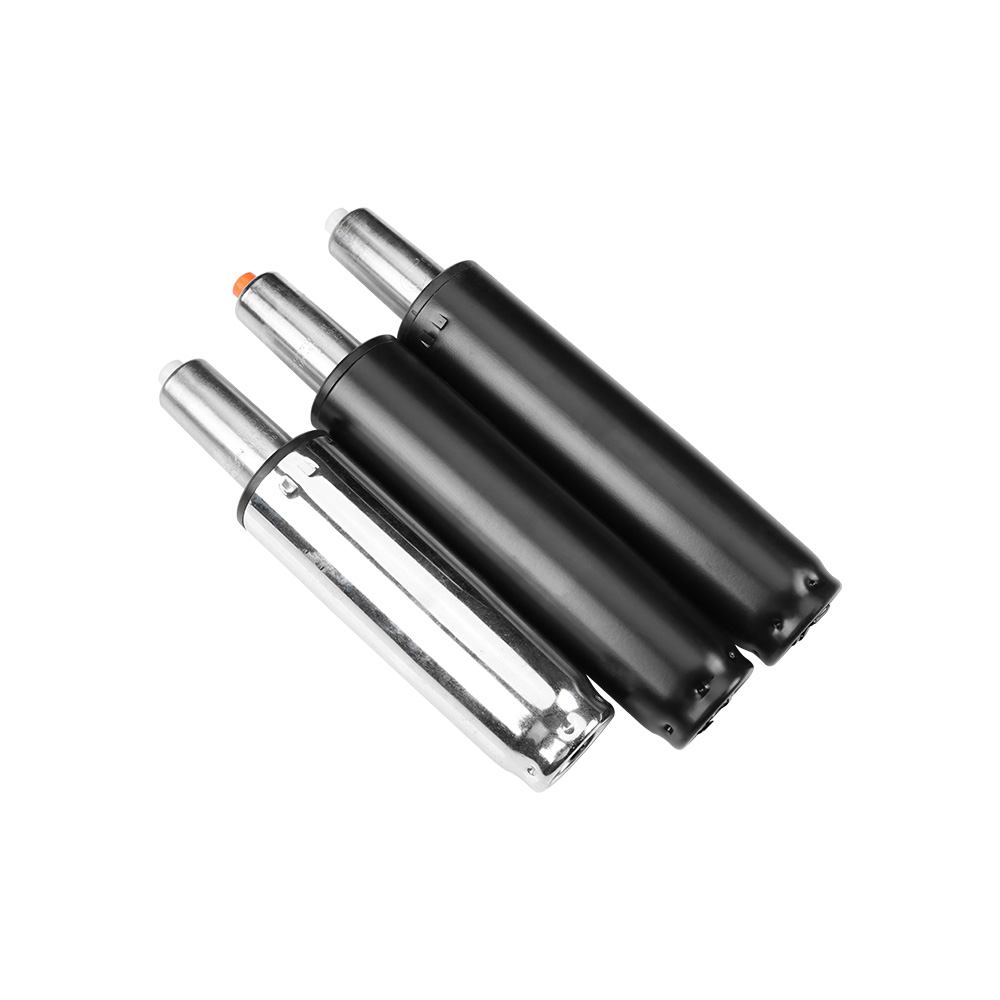
The fundamental rule of specifying hardware is that its material strength and thickness must exceed the maximum force output of the gas spring. A mismatch here is a primary cause of mechanical failure. For instance, if you are designing premium office seating or bar chairs, you might specify 60mm black chrome gas lift cylinders. These specific cylinders require exact mating hardware in the base to prevent the chair from wobbling over time.
Engineers must calculate the total load, including the weight of the object being lifted, the angle of installation, and the leverage point. High-force industrial applications typically require reinforced components made from heavy-gauge carbon steel. This offers superior tensile strength and resistance to deformation under continuous stress.
A gas spring is only as secure as its threaded connection. The piston rod and the cylinder end feature specific thread sizes, most commonly M6, M8, or M10. It is a critical engineering requirement that the thread size of the spring perfectly matches the internal threading of the chosen end fittings.
Attempting to force a mismatched thread, or using components with poor machining tolerances, can easily strip the threads. Under the high internal pressure of the nitrogen gas, a stripped thread can cause the end fitting to detach explosively. Precise compatibility eliminates micro-movements at the joint. This prevents premature wear and maintains the structural stability of the entire assembly over tens of thousands of cycles.
Looking at the broader manufacturing landscape, we are currently seeing a massive shift in how OEMs approach mechanical support systems. As sectors like electric vehicle manufacturing and smart ergonomic furniture expand, the demand for lightweight yet ultra-high-strength hardware is surging. Engineers are increasingly moving away from standard zinc-plated steels. Instead, the trend heavily favors advanced alloys and specialized composite materials.
These modern alternatives offer superior tensile strength without adding unnecessary weight to the final product. Global supply chains now demand components that can survive extreme thermal cycling and corrosive environments for decades, rather than just a few years. This evolving trend underscores a critical reality in our field. Investing in precision-machined, corrosion-resistant hardware is no longer just a premium option. It is a baseline requirement for modern mechanical engineering safety and efficiency.
While gas springs provide the essential lifting power for your applications, it is the accessories that guarantee stability, safety, and longevity. Skipping quality brackets or relying on generic joints often leads to broken struts, damaged equipment, and costly downtime down the line. By choosing durable, precisely matched components, you protect your mechanical investments and ensure flawless operation.
Do not let cheap hardware compromise your engineering. Evaluate your environmental stressors, match your force requirements to the right materials, and build a system designed to last. For precision-machined components tailored to your exact specifications, explore the full range of professional-grade solutions at Mirui Gas Spring to ensure your next project operates flawlessly.
While it is physically possible, it is highly recommended that you conduct a rigorous visual and tactile inspection first. Look for any signs of hairline cracks, metal fatigue, or elongation of the mounting holes. If the new gas spring has a higher force rating in Newtons than the original, you must install a new, stronger bracket to handle the increased load safely.
A clevis fork provides a highly rigid, single-axis pivot point, restricting movement strictly to an up-and-down motion. This is ideal for perfectly aligned, heavy-duty applications. In contrast, a spherical joint allows for multi-directional movement and articulation. This multi-axis freedom is superior for applications where slight side-to-side shifting or chassis flexing occurs, as it prevents lateral stress on the shaft.
Rapid pressure loss is almost always caused by side-loading or incorrect installation angles. If the mounting hardware forces the piston rod to bend slightly during compression, the rod scrapes against the internal seals. This creates microscopic abrasions that allow the nitrogen gas to leak out. Upgrading to self-aligning spherical joints usually solves this problem permanently.
The mounting angle depends on the weight of the lid, the location of the hinge, and the desired opening angle. As a general engineering rule of thumb, the mounting point on the moving application should be located at approximately twenty percent of the total length of the lid away from the hinge. The strut should be positioned so that it pushes past the center of gravity when fully closed, keeping the lid securely shut.
No, they are highly specific. Accessories are manufactured with varying thread sizes, different pitch measurements, and distinct weight load capacities. You must cross-reference the exact specifications, particularly the thread size and the maximum force output of your specific strut, to ensure you select compatible and safe hardware.


