

close
Choose Your Site
Global
Social Media

Author: Site Editor Publish Time: 2026-07-31 Origin: Site
Upgrading to a heavier 10-inch memory foam or hybrid mattress—especially in RVs and residential platform beds—frequently results in the immediate failure of existing under-bed storage lift mechanisms. Factory-installed gas struts are strictly calibrated for specific, lightweight OEM mattresses. Exceeding this limit compromises usability, eliminates the counterbalance effect, creates a major safety hazard when accessing under-bed storage, and causes accelerated component wear. Selecting a replacement requires a technical evaluation of the new weight delta, precise force calculations, and an assessment of the existing mounting geometry to restore safe, controlled, and hands-free motion. You cannot simply guess the required pressure. You must measure the physical dimensions and calculate the exact load requirements based on the new mattress weight to ensure the system functions correctly and safely.
Mattress and platform weight directly dictate the required Newton (N) or pound-force (lbs) rating of the replacement gas spring.
Force calibration is a strict balancing act: under-specced springs cause the platform to collapse, while over-specced springs prevent closure or cause violent, uncontrolled opening.
Mounting geometry and pivot points are just as critical as the force rating; altering the angle changes the mechanical advantage and required lifting force.
Upgrading to higher-capacity struts introduces new structural stresses on the bed frame, requiring hardware and bracket reinforcement.
The standard mattress supplied with most recreational vehicles and factory-built platform beds is designed with one primary goal: weight reduction. Manufacturers frequently install thin, low-density foam mattresses that weigh between 30 and 45 pounds. The factory-installed lift mechanisms are calibrated specifically for this minimal load. When you remove that lightweight mattress and replace it with a dense, multi-layer 10-to-12-inch memory foam or natural latex mattress, the weight of the bed can easily jump to 90, 120, or even 150 pounds. This massive weight deficit immediately overwhelms the original hardware.
Adding this much weight fundamentally changes the center of gravity on the lifting platform. The load distribution across the hinges and the lifting mechanisms shifts dramatically. In a factory setup, the center of gravity is relatively close to the pivot point, allowing lower-force struts to manage the load. With a heavy memory foam mattress, the mass is distributed further out along the platform, increasing the leverage working against the hinges. The mechanical failure point occurs when the existing strut's internal nitrogen gas pressure can no longer overcome the static load of the platform and mattress. At this stage, the counterbalance effect is entirely lost. The user is forced to provide 100% of the manual lifting force, which often exceeds 80 pounds of dead weight, making the storage compartment practically inaccessible.
Installing replacement struts without calculating the exact required force leads to severe operational and safety issues. Under-gassing occurs when you install weak struts that lack the internal pressure to support the new mattress weight. The immediate risk is the inability to hold the bed open. The platform may lift initially but will slowly sink or suddenly collapse. This introduces a massive risk of physical injury. If you are reaching into the storage compartment and the platform falls, the heavy mattress and wood frame can cause severe trauma to your head, neck, or back.
Over-gassing presents a different set of dangerous mechanical problems. When struts are too strong, they overcompensate for the weight. The most common symptom of over-gassing is the complete inability to compress the strut to close the bed. You might find yourself hanging your entire body weight on the end of the bed frame, and it still refuses to lower. This excessive upward force places severe stress on the hinges and the wood frame. The constant pressure can cause the platform to bow upward when closed, or worse, snap the wooden frame entirely. Proper calibration ensures the strut acts as a reliable holding mechanism, allowing users to safely use both hands to access storage without fear of the platform slamming down or refusing to close.
| Calibration Error | Mechanical Symptoms | Safety & Structural Risks |
|---|---|---|
| Under-Gassed (Too Weak) | Platform sags, fails to stay open, requires heavy manual lifting. | High risk of sudden collapse, causing physical injury to the user. |
| Over-Gassed (Too Strong) | Platform refuses to close, violent upward opening motion. | Hinge tear-out, bowed platform frame, inability to secure the bed. |
| Incorrect Stroke Length | Platform does not open fully or bottoms out before closing. | Internal seal damage to the strut, restricted access to storage. |
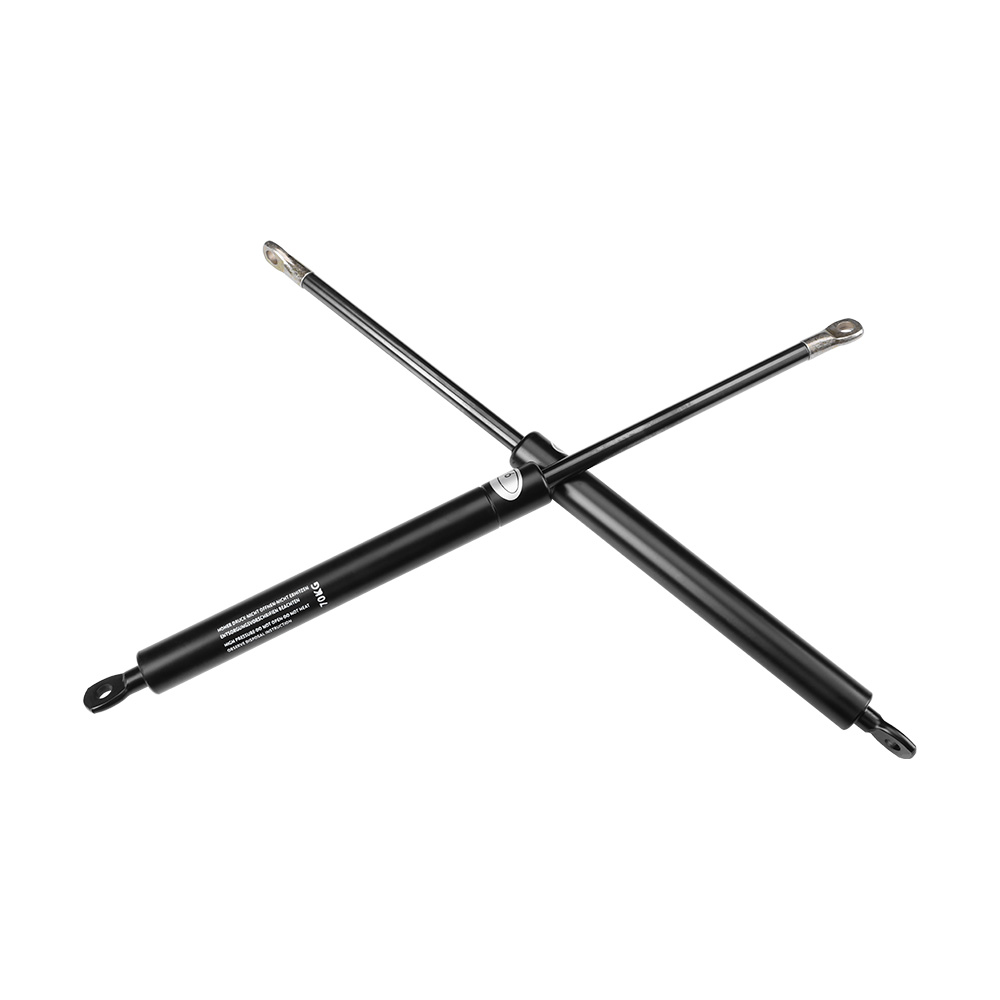
Determining the correct force for your replacement struts requires basic math and accurate measurements. You cannot guess this number based on the size of the bed alone; a king-size innerspring weighs differently than a king-size dense latex mattress. The standard unit of measurement for these components is Newtons (N), though many North American suppliers list them in pound-force (lbs). As a general conversion, 10 pounds of force is roughly equal to 45 Newtons.
To calculate the required lift, you must determine the total weight of the platform door and the mattress combined. Once you have the total weight, you divide it by two, assuming you are using a standard dual-strut system. However, because the struts are mounted at an angle and lift from a pivot point rather than pushing straight up, you must apply a leverage multiplier. A common rule of thumb for standard bed geometries is to multiply the half-weight by 1.2 to 1.5 to account for the mechanical disadvantage of the mounting angle.
Remove all bedding and weigh the mattress using a standard bathroom scale.
Prop the empty wooden platform open and use a luggage scale to pull down on the edge to estimate the platform's dead weight.
Add the mattress weight and platform weight together to get the total load.
Divide the total load by two for a dual-strut setup.
Multiply that number by 1.3 to account for the mounting angle leverage.
Select a strut with a force rating that closely matches this final calculated number.
Industry standard upgrade pathways usually follow predictable jumps. If you are transitioning from a standard OEM 80 lb force strut because you added a heavy queen mattress, you will typically need to upgrade to a 120 lb or 150 lb rated strut. Proper force selection ensures controlled damping at the end of the stroke. High-quality struts feature a hydraulic damping zone at full extension, preventing sudden, jarring stops that stress wood and metal joints.
Force is only half the equation; physical dimensions dictate whether the strut will actually fit and function in your bed frame. The extended length is the total distance from the center of the top mounting ball stud to the center of the bottom mounting ball stud when the strut is fully uncompressed. To measure this, prop your bed open to the exact height you want it to rest at when accessing storage. Measure the distance between the two mounting brackets. Your replacement strut must match this extended length within a half-inch tolerance.
Stroke length is the distance the internal piston rod travels into the cylinder. You must verify that the stroke length is sufficient to accommodate the fully closed position. If the stroke is too short, the internal piston will bottom out against the base of the cylinder before the bed is fully closed, leaving the platform hovering an inch or two above the base. Conversely, if the cylinder body is too long, it will physically block the bed from shutting. Always measure the compressed distance between the mounting points when the bed is closed to ensure the strut's compressed length is shorter than the available space.
Not all lifting mechanisms are built to the same specifications. Standard-duty systems are engineered for lightweight frames, guest beds, and standard innerspring mattresses. These components use thinner steel cylinders and standard seals designed for occasional use. They are perfectly adequate for a spare bedroom where the storage compartment is accessed a few times a year.
Heavy-duty residential and RV systems are mandatory when dealing with solid wood platforms or master beds equipped with thick memory foam. These industrial-grade components feature thicker cylinder walls, reinforced mounting eyes, and heavy-duty internal seals capable of withstanding high internal nitrogen pressures. Access frequency plays a massive role in component selection. If you access your under-bed storage daily, the wear cycles on the internal seals increase exponentially. Heavy-duty struts maintain their gas retention far longer under frequent cycling compared to standard applications.
It is a common mistake to assume that any pneumatic cylinder can be used to lift a bed. A bed lift gas spring requires a massive load-bearing capacity and a long stroke length. This contrasts sharply with a standard furniture gas spring, which is typically designed to assist in opening lightweight storage ottomans or small trapdoors. The force profiles are entirely different.
Similarly, a sofa gas spring is engineered for short, heavy bursts of force to recline a seat back, operating at different pivot angles than a bed platform. The mechanics of a chair gas lift involve vertical compression to support the static weight of a seated person, whereas a bed lift relies on angled leverage to push a platform upward on a hinge. You cannot substitute these parts. Furthermore, a cabinet gas strut is entirely useless for bed platforms due to a severe mismatch in load capacity—often rated for 10 to 20 pounds—and a stroke length that is far too short to lift a large wooden frame.
The placement of the mounting brackets dictates the mechanical advantage of the entire system. Moving the lower mounting bracket even one inch closer to the hinge drastically increases the leverage the strut has on the platform, but it also drastically increases the required strut force to initiate the lift. If you move the bracket further away from the hinge, the strut requires less force to lift the bed, but it must have a significantly longer stroke length to allow the bed to open fully.
Maintaining the correct operational angle is necessary to ensure the strut provides maximum lift when closed and stabilizes when open. If the angle is too shallow when the bed is closed, the strut pushes horizontally against the hinge rather than vertically against the platform, making it incredibly difficult to start the lifting motion. The geometry must be precise to ensure a smooth, controlled arc from closed to fully open.
Upgrading to higher-force springs introduces severe structural risks to the bed frame itself. Most RV bed frames and affordable residential platforms are constructed from MDF, particleboard, or thin plywood. When you install a 150-pound strut, that force is transferred directly into the mounting screws. Higher-force springs risk tearing standard wood screws straight out of these weak materials, destroying the frame and causing the strut to violently detach.
Mitigation tactics are required when upgrading. Never rely on the factory half-inch wood screws when installing heavy-duty struts. Replace standard wood screws with through-bolts that pass entirely through the wooden frame, secured with nylon lock nuts on the opposite side. Use wider steel backing plates to distribute the load across a larger surface area of the wood. Upgrading to heavy-duty steel mounting brackets with multiple fastening points will prevent the hardware from twisting or tearing out under the immense pressure of the upgraded lifting mechanism.
The weight of the mattress and platform is the single most critical variable in designing, evaluating, or replacing a bed lift system. Ignoring this metric guarantees mechanical failure, structural damage, or physical injury. When selecting a replacement, prioritize an exact match for extended and compressed lengths first, then scale the force rating proportionally to the weight delta of the new mattress.
Physically weigh your new mattress and the wooden platform to determine the exact total load.
Measure the existing strut dimensions center-to-center while the bed is fully open to find the required extended length.
Inspect your current wooden frame and upgrade the mounting hardware to through-bolts and steel backing plates before installing stronger struts.
Source a calibrated replacement from a reputable manufacturer that matches your calculated force requirements.
A: Weigh the mattress and platform, divide by the number of struts, and multiply by 1.3 to factor in the mounting angle leverage. Consult manufacturer guidelines for precise adjustments based on your specific bracket locations.
A: Yes, if you have upgraded to a heavier mattress. However, using a strut that is too strong for the current weight will prevent the bed from closing properly and can damage the frame.
A: The struts are likely over-gassed for the weight of your mattress and platform, or the mounting geometry provides insufficient mechanical advantage to compress them. You need lower-force replacements.
A: Bed lift struts require significantly higher force ratings, thicker cylinders, and longer stroke lengths to handle heavy, angled loads compared to lighter cabinet or standard furniture applications.
A: Yes. The mounting angle dictates the mechanical leverage. Changing the pivot points directly alters the amount of force required to lift and hold the platform safely.


